· 5 min read
How We Built a No-Code Landing Page Editor That Ships Static Pages in Minutes
We automated ourselves out of changing hex codes for a living.
 Pritam Sharma
title: "How We Built a No-Code Landing Page Editor That Ships Static Pages in Minutes" subtitle: "We automated ourselves out of changing hex codes for a living." date: 2026-04-13T09:51:59.541Z url: https://blog.notpritam.in/how-we-built-a-no-code-landing-page-editor-that-ships-static-pages-in-minutes tags: [no-code, react, web]#
How We Built a No-Code Landing Page Editor That Ships Static Pages in Minutes#
We got tired of changing hex codes for a living. So we automated ourselves out of the job.
The Old Way (Pain)#
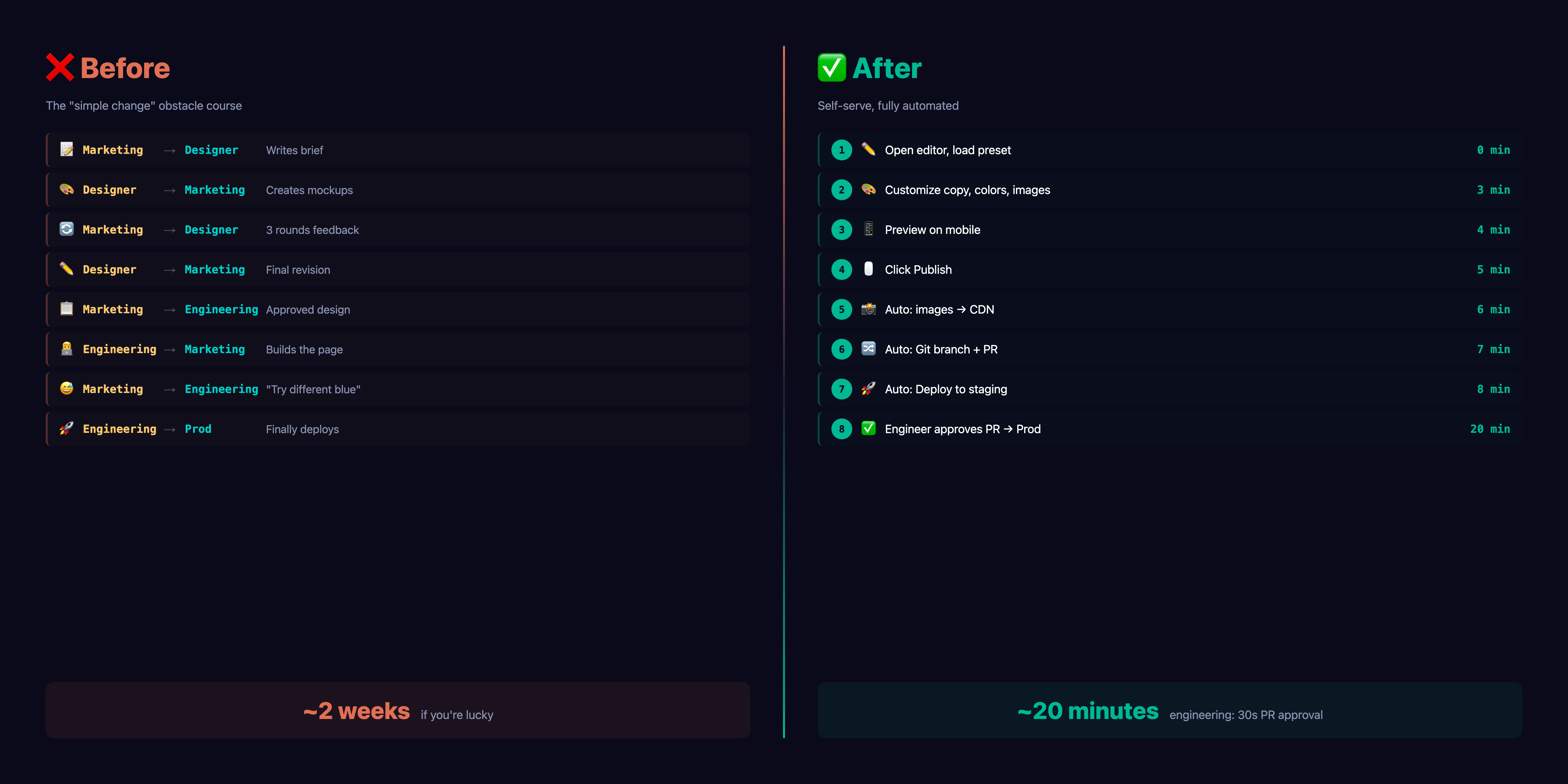
Every "small" landing page change went through this obstacle course:
-
Marketing has an idea
-
Designer mocks it up (3 rounds of feedback)
-
Engineer builds it (next sprint, maybe)
-
Marketing: "Can we try a different blue?"
-
Back to step 2
-
Engineer: quietly updates resume
One landing page? Fine. Twenty pages, three languages, influencer-specific variants, each with custom pricing? We were drowning.
The chain was the problem: Marketing -> Designer -> Engineer -> Designer -> Engineer -> Deploy. We needed: Marketing -> Deploy.
The Core Idea#
Every landing page is a JSON file.
Not "backed by" JSON. The JSON is the page — every heading, color, image, testimonial, pricing plan, CTA button. At build time, the static site generator reads the JSON and bakes it into pre-rendered HTML. No database. No CMS. No API calls at runtime.
Recipe goes in, cake comes out. Visitor gets the cake instantly.
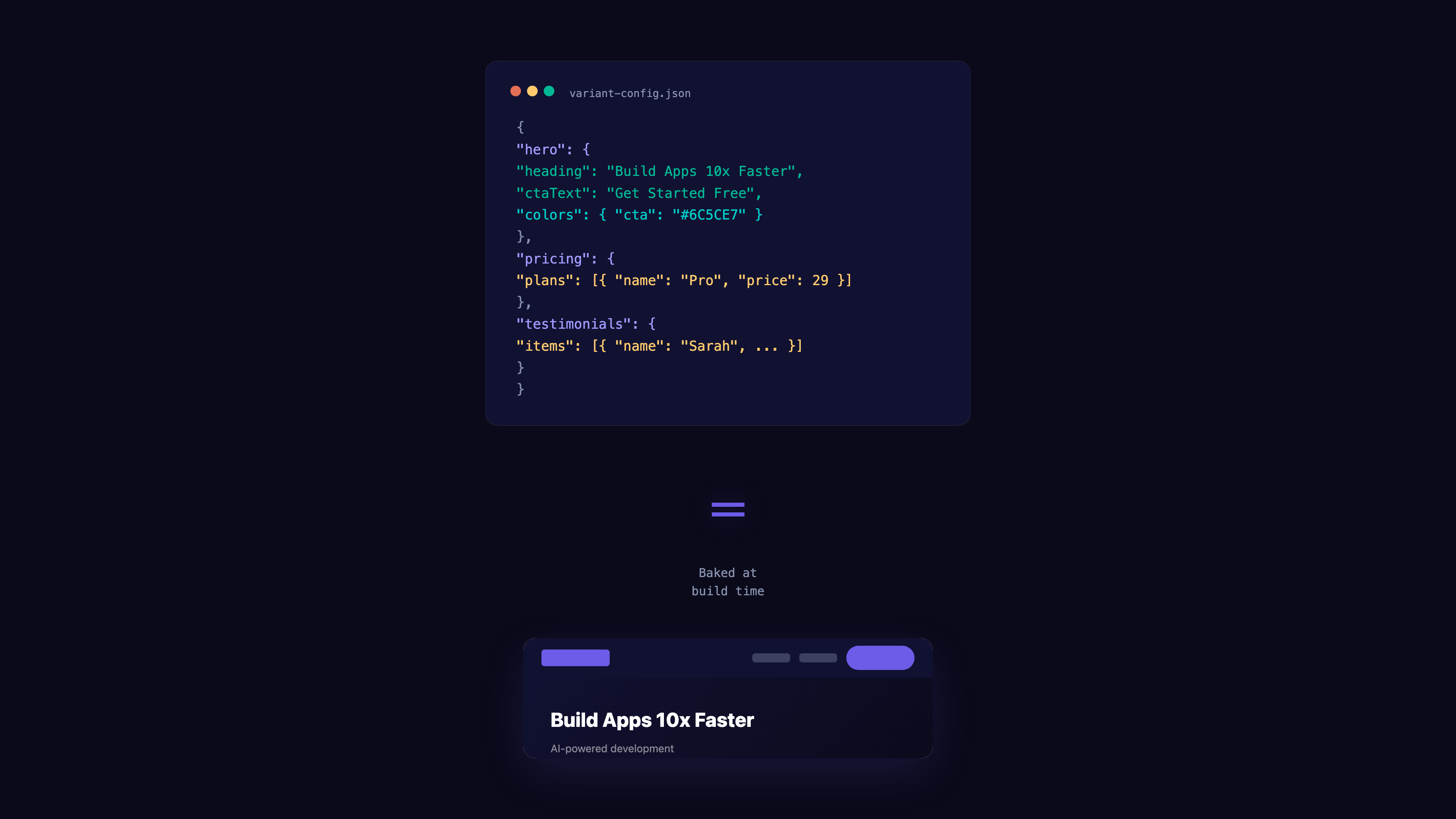
{
  "hero": {
    "heading": "Build Your App 10x Faster",
    "ctaText": "Get Started Free",
    "colors": { "heading": "#FFFFFF", "ctaBackground": "#6C5CE7" }
  },
  "pricing": {
    "plans": [
      { "name": "Pro", "monthly": 29, "features": ["Unlimited projects", "Priority support"] }
    ]
  },
  "testimonials": {
    "items": [
      { "name": "Sarah Chen", "role": "CTO", "quote": "Saved us 200 engineering hours." }
    ]
  }
}
Change the headline? Edit one string. New testimonial? Add an object. Different pricing for France? Swap the numbers. Done.
Architecture#
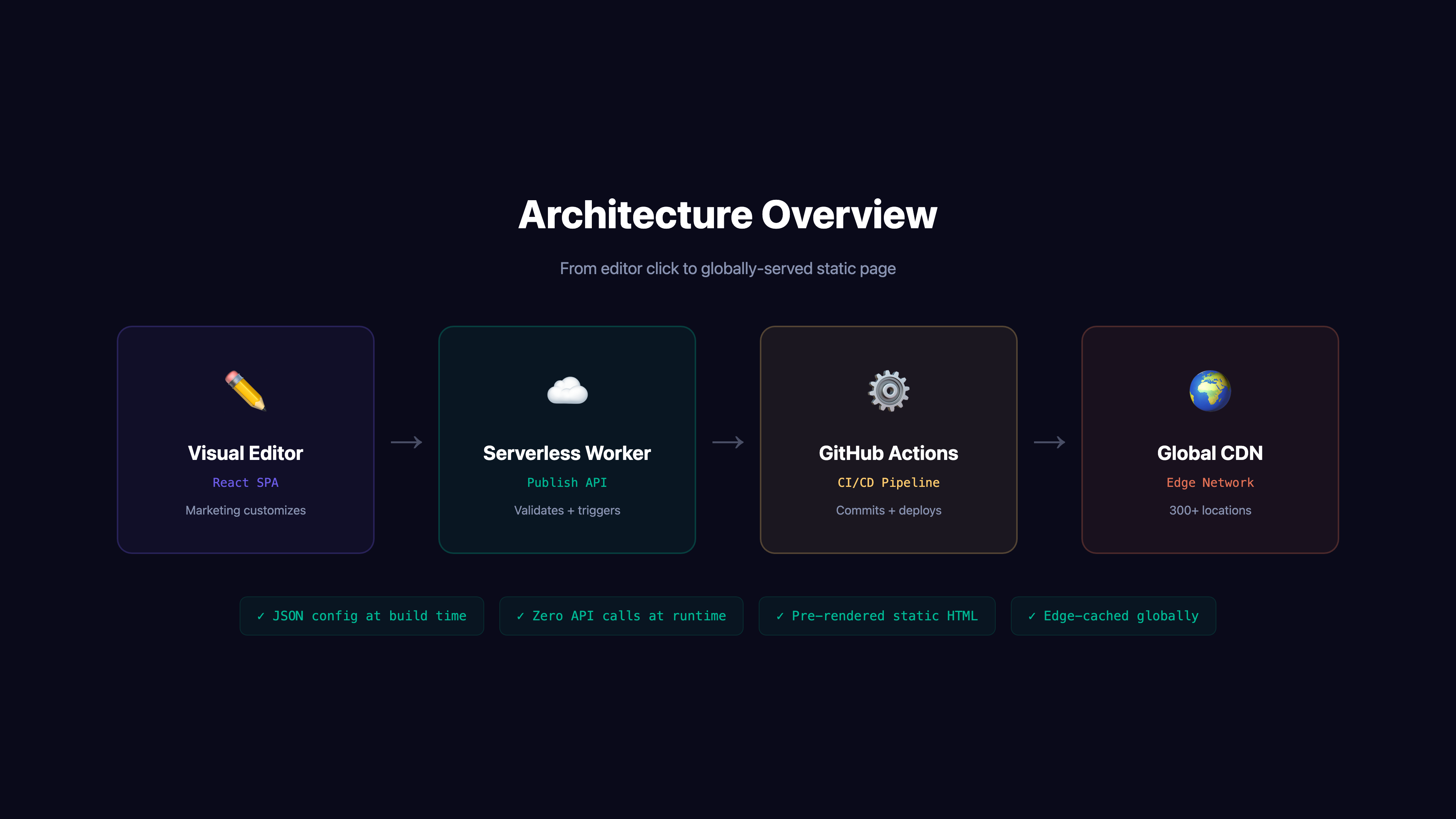
Four pieces:
-
Visual Editor — Marketing customizes pages. Spits out JSON.
-
Serverless Worker — Uploads images, validates config, triggers the build.
-
GitHub Actions — Commits config to Git, opens a PR, deploys.
-
Global CDN — Serves static HTML from 300+ edge locations.
Marketing clicks a button. A Git commit happens. They don't need to know that.
The Editor#
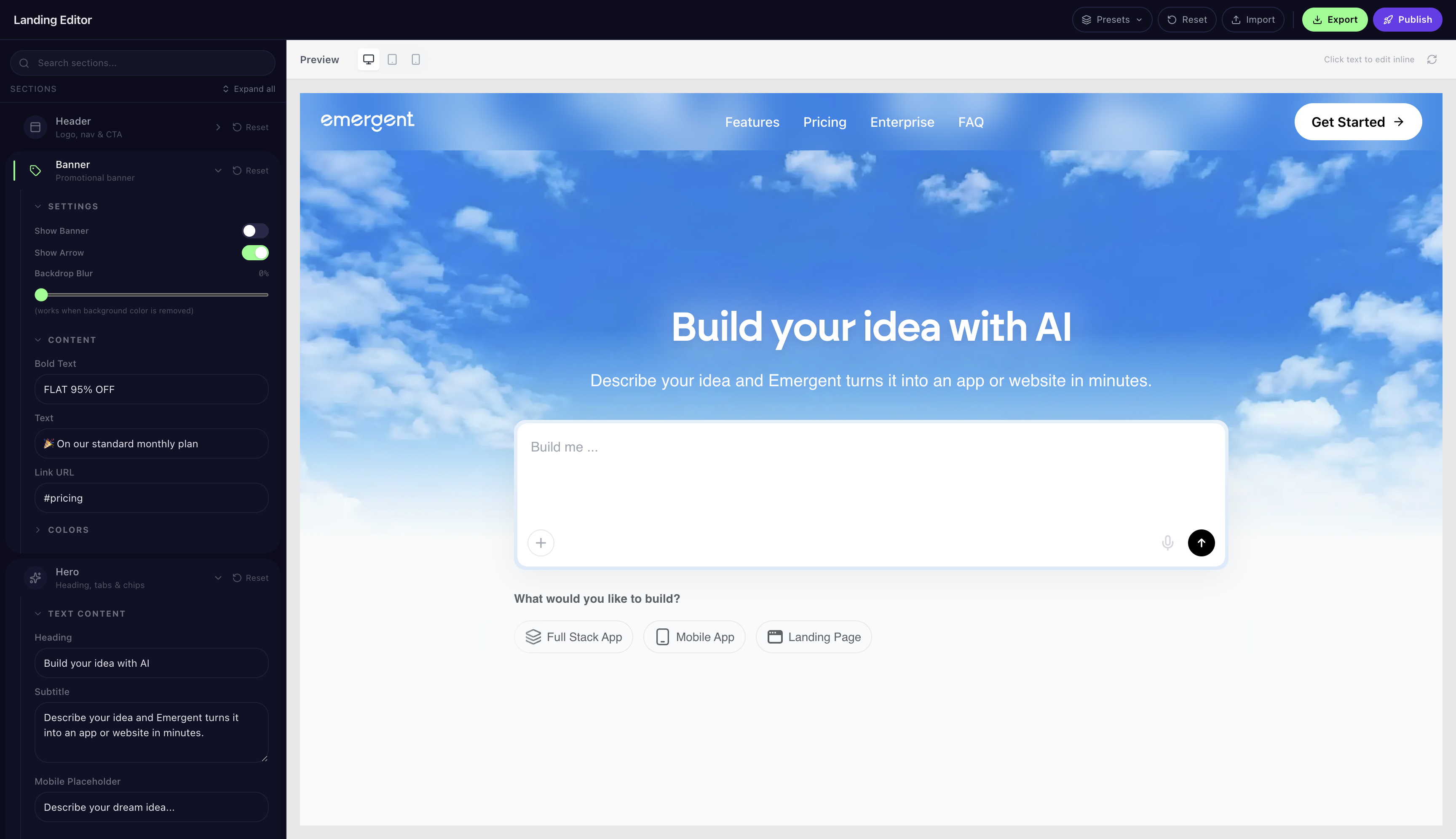
Three panels. That's it.
-
Left sidebar: 12 section editors (Hero, Pricing, Testimonials, FAQ, etc.) with fields for text, colors, images, toggles
-
Right panel: Live preview of the actual page. Viewport switching — Desktop, Tablet, Mobile
-
Top toolbar: Publish, presets, reset
Every field maps to a path in the JSON. Change a color picker, the preview updates instantly. It's all local state — no network calls during editing.
Auto-save to localStorage means marketing can close the browser, come back tomorrow, pick up where they left off. We also built a presets system — save configs as reusable templates. Marketing built a library of these within the first week without us asking.
The Publish Pipeline#
Marketing clicks "Publish." Here's what happens in the next 3 minutes:
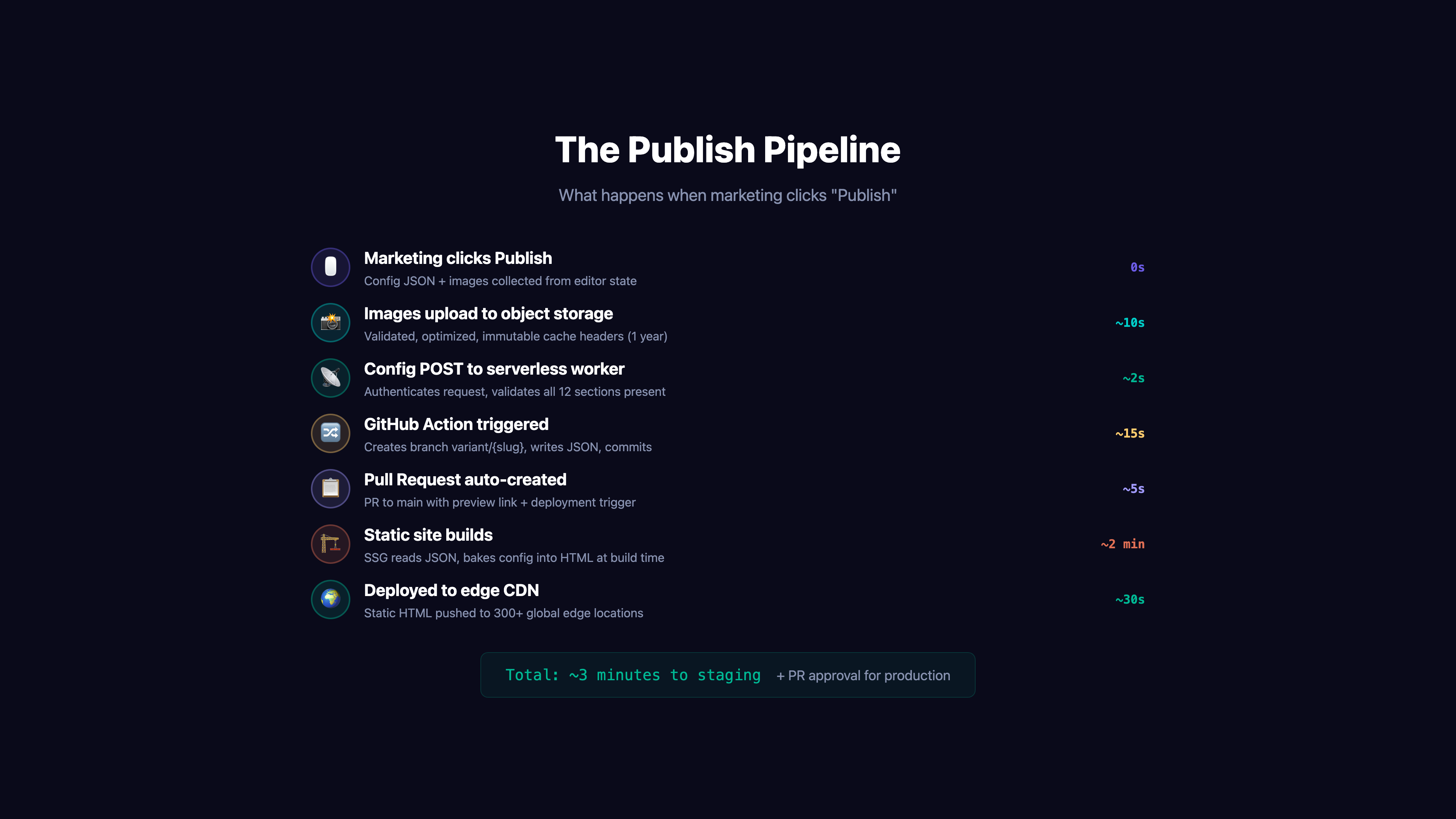
sequenceDiagram
    participant M as Marketing
    participant W as Worker
    participant G as GitHub Actions
    participant CDN as CDN

    M->>W: Uploads images + config JSON
    W->>G: Triggers build workflow
    G->>G: Creates branch, commits config, opens PR
    G->>CDN: Deploys to staging
    G-->>M: Preview URL ready
    Note over M,CDN: Engineer approves PR (~30 sec)
    G->>CDN: Deploys to production
Image upload: Scans config for images, uploads to object storage with immutable cache headers (cached for a year). Validates file types. No, marketing, you cannot upload a 50MB PSD.
Slug generation: Auto-generates from the heading. Detects collisions, appends -v2, -v3.
CI/CD: Creates a Git branch, writes the JSON config, commits, opens a PR, triggers deploy. All automated.
gitGraph
    commit id: "main"
    branch variant/summer-sale
    commit id: "publish summer-sale"
    checkout main
    branch variant/influencer-alex
    commit id: "publish influencer-alex"
    checkout main
    merge variant/summer-sale
    merge variant/influencer-alex
The zero-load-time trick: The config gets baked into static HTML at build time. When a visitor loads the page, everything is already there — colors, copy, images, pricing. No API calls. No loading spinners. The page is "done" before JavaScript even loads.
Performance#
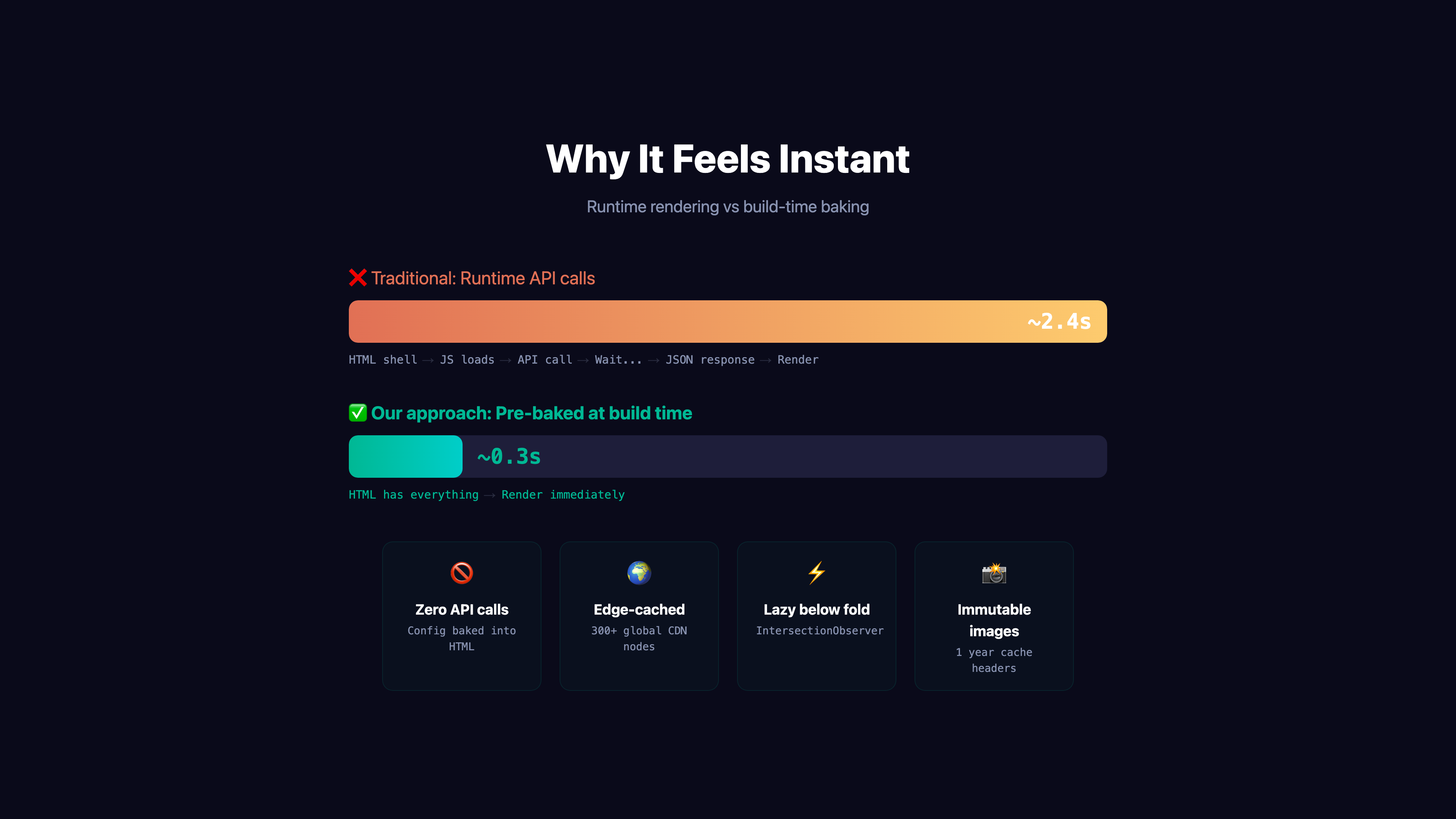
Two-tier loading: Hero, social proof, and testimonials render immediately. Pricing, FAQ, and video lazy-load via IntersectionObserver with 100px look-ahead. By the time you scroll there, it's ready.
Edge delivery: Static HTML on a global CDN. No origin server. Brotli compression. Your page loads fast whether you're in Mumbai or Montreal.
Analytics that don't block paint: PostHog and monitoring load async. Section visibility tracking fires events as sections enter the viewport — marketing gets funnel data without us sacrificing a millisecond.
Variants: Languages, Influencers, Campaigns#
This is where it gets fun.
Language variants: Duplicate a preset, translate the copy, adjust pricing. Publish. Fully localized page in minutes, no i18n library needed.
Influencer pages: Custom colors matching their brand, their testimonial front and center, tailored hero copy, unique pricing. They get a custom URL. Their audience gets a page that feels hand-built — because it is.
Safety net: Every variant is a Git commit. Marketing published something broken? git revert. 30 seconds. Try doing that with a CMS.
Idea to Live Page: The Timeline#
timeline
    title 20 Minutes, Start to Finish
    0 min : Open editor, load a preset
    3 min : Customize copy, colors, pricing, testimonials
    5 min : Preview on mobile, tweak, hit Publish
    8 min : Staging deploy complete, verify preview
    15 min : Engineer approves PR
    20 min : Live on production, globally
Old flow: 1-2. New flow: 20 minutes. Engineering's involvement: a 30-second PR approval.
What We'd Do Differently#
Config bloat: Each variant JSON is ~38KB because it stores everything, including defaults. Storing only overrides would cut this by 80% and make PR diffs actually readable.
Single-player editing: localStorage means one person per browser. Two marketers editing simultaneously = last one wins. Real-time collab would fix this, but hasn't been needed yet.
Preview speed: The "real" preview requires a staging deploy (~3 min). An on-demand render function would make this instant.
TL;DR#
-
JSON config = entire page. Git = CMS. PR = content approval.
-
Static generation means zero API calls at runtime. Pages load instantly.
-
Marketing clicks Publish, automation handles the rest. Engineering reviews at their pace.
-
Every variant is a Git commit. Rollbacks are a
git revertaway.
Marketing went from "file a ticket and wait two weeks" to "ship it yourself in 20 minutes." Engineering went from "change hex codes" to "approve PRs over coffee."
Everyone's happier. Especially the engineer.
Building something similar? Hit me up — happy to nerd out about config-driven UIs and making marketing teams dangerously autonomous.
More writing

Award Winning Marquee Animation with Framer Motion
Have you ever wondered, how do they create such smooth and beautiful animations in their site ? Worry not, in this article i will be guiding you through how you can create such amazing award winning…
 Pritam Sharma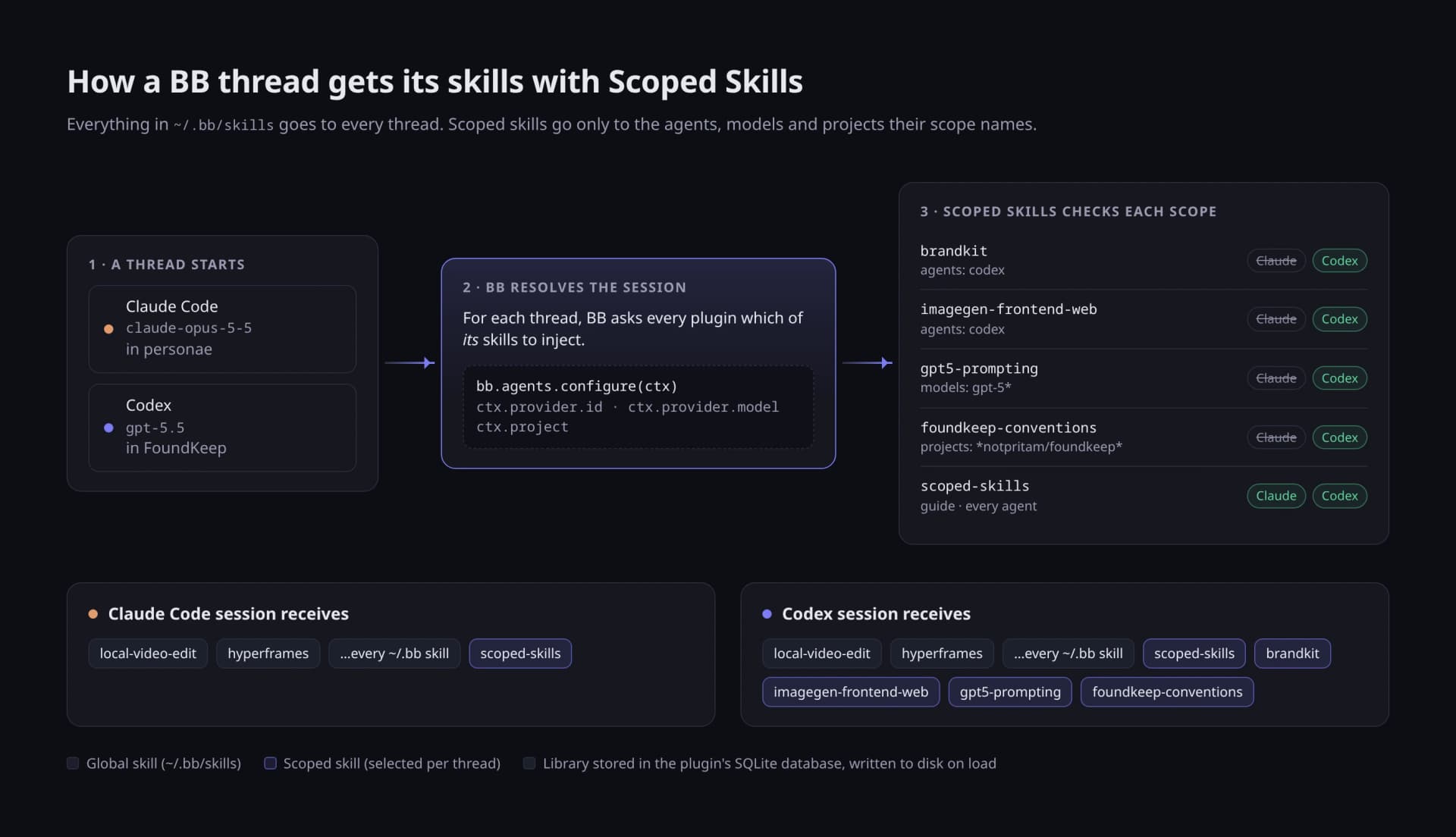
My agents don't all need the same skills, so I made bb stop handing them out
Scoped Skills gives a skill only to the agents, models and projects that should have it. It started as a cleanup and ended as a plugin, and the part that decides who gets what is a few dozen lines.
Pritam Sharma